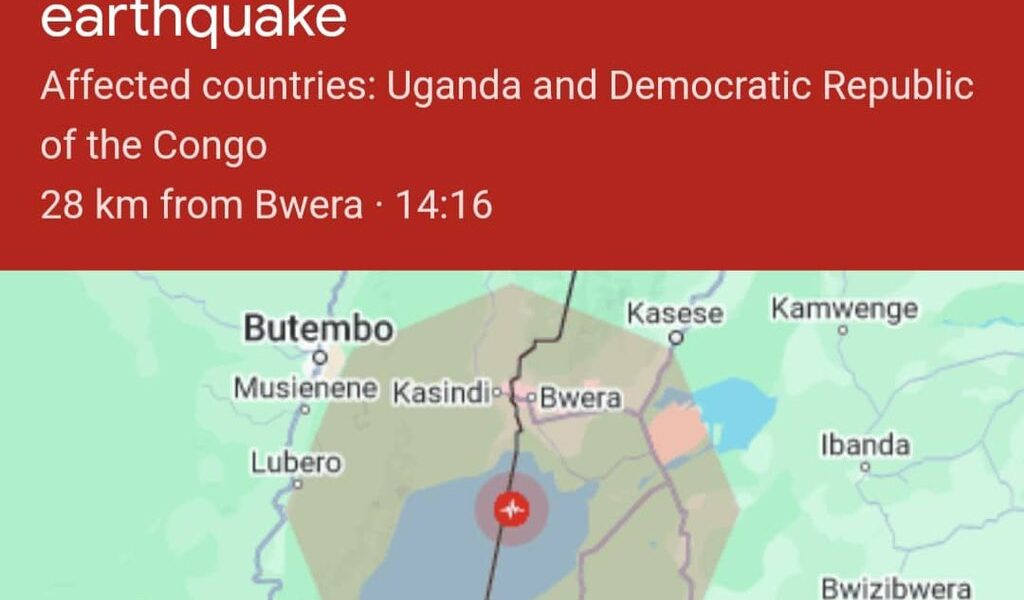

A magnitude 4.5 earthquake rattled Uganda on Sunday evening, with tremors felt in several regions and residents describing moments of fear as buildings shook and strange sounds echoed beneath the ground.
The earthquake struck at around 9:19 PM local time, with its epicentre located near Nakasongola in central Uganda. According to international seismic agencies, the event registered a magnitude of approximately 4.5, making it one of the most widely felt earthquakes in the country in recent months.
Many residents reported that the shaking lasted several seconds and was accompanied by loud rumbling noises. Some initially believed heavy vehicles or storms were causing the disturbance before realizing an earthquake had occurred.
Uganda’s geological position along the Albertine Rift places it within one of Africa’s most active tectonic regions. Earthquakes ranging between magnitudes 4 and 6 are not uncommon, although stronger events have occasionally occurred in the country’s history.
The most powerful earthquake associated with Uganda’s seismic zone was recorded in May 1990, when a magnitude 7.2 quake struck near the border with the Democratic Republic of Congo. More recently, a magnitude 5.9 earthquake in 2016 caused widespread shaking across central and western Uganda.
Although no immediate reports of casualties or major damage emerged from Sunday’s earthquake, experts are continuing to monitor the situation for possible aftershocks. Geological authorities are expected to provide further updates as investigations continue.
The latest event highlights the ongoing tectonic activity beneath Uganda and serves as a reminder of the importance of earthquake preparedness in communities across the country.